Healthy Chocolate Cake

Here are two different and super easy versions – one gluten free and the other gluten AND nut free – of my son’s favourite cake.
Pamela delighted in treating him to these, as well as ‘wibbs’ (aka barbecue spare ribs, soon to be posted).

1. FLOURLESS CHOCOLATE CAKE (based on Donna Hay’s)

200g dark chocolate
140g butter
5 separated eggs
1/2 cup caster sugar (4oz / 125g)
1 1/2 cups ground almonds (12oz)
icing sugar for dusting

Heat oven to 160 degrees. Grease a cake tin and line base with greaseproof paper. (I use a 9 inch or 23cm diameter round.)
In a large mixing bowl, melt chocolate and butter together, either in a bowl above hot water or (I do it) in the microwave bit by bit (see note below.) Cool slightly.
Stir in the egg yolks, sugar and almonds to the chocolate mix; and put aside.
Beat egg whites until stiff and glossy.
Gently fold egg whites into the mixture.
Spoon into tin and bake for approximately 45 mins or until cooked through (see note below).
Cool and turn out onto your favourite cake plate or stand and dust with icing sugar. A few berries on top would be nice too.

NOTES:

  1. If melting chocolate and butter in microwave do it a little by little, taking care not to burn; e.g. 30 secs, stir with a small whisk, 30 secs, stir, until smooth.
  2. Pierce cake with  a wooden skewer to test if cake is ready. If it comes out clean, it is; if not cook for a little longer.
  3. The cooking time is based on my fan-forced oven. Other ovens may take a bit longer or in the top oven of an Aga the cake may be cooked after 40 minutes.
  4. This tastes best the day after baking.
  5. If having difficulties understanding Australian measurements – check here: https://www.donnahay.com.au/recipes/conversion

2. HEALTHIEST CHOCOLATE CAKE EVER (based on Teresa Cutter’s)

200g dark chocolate, melted
60ml melted butter or coconut oil
1/4 cup coconut flour (2 oz / 60g)
1 and 1/2  teaspoon gluten free baking powder
A grind or two of sea salt
4 eggs whisked
3 tablespoons organic honey or maple syrup
1 teaspoon vanilla

Heat oven to 160 degrees. Grease a cake tin and line base with greaseproof paper. (I use a 9 inch or 23cm diameter round.)
In a large mixing bowl, melt chocolate, butter and honey together, either in a bowl above hot water or (I do it) in the microwave bit by bit (note above.) Cool slightly.
Stir in the dry ingredients: coconut flour, baking powder and a grind of sea salt, until well combined.
Whisk the eggs and vanilla and stir into the rest of the mixture.
Spoon into cake tin and cook for around 40 minutes.
Cool and turn out onto your favourite cake plate or stand.  Serve with natural yoghurt, shaved dark chocolate and fresh berries. (A swirl of lavender syrup is super addition too.)

NOTES:

  1. This recipe is super quick  – if you want, just fling all the ingredients into a bowl and mix together with a hand whisk.
  2. This cake will rise well but not enormously, for a lighter cake, reduce baking powder to 1/2 teaspoon and separate your eggs as per recipe no.1. (stir in the yolks, whisk the whites and fold them into the mixture.)
  3. If you can’t find coconut flour and you don’t have to be nut-free, use 1 1/2 cups of almond or hazelnut meal instead.
  4. This cake is not super sweet, if you prefer sweeter then I suggest using maple syrup instead of honey and dust with icing sugar.
  5. If baking this recipe as cup cakes, only bake for 20 minutes.

Enjoy! ..and don’t forget to tell me how it works out for you. I’ll add some photos soon.
My, oh, my! Sugar high!

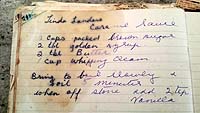
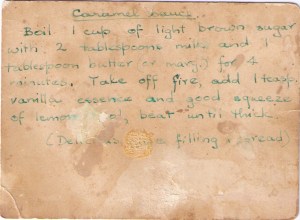
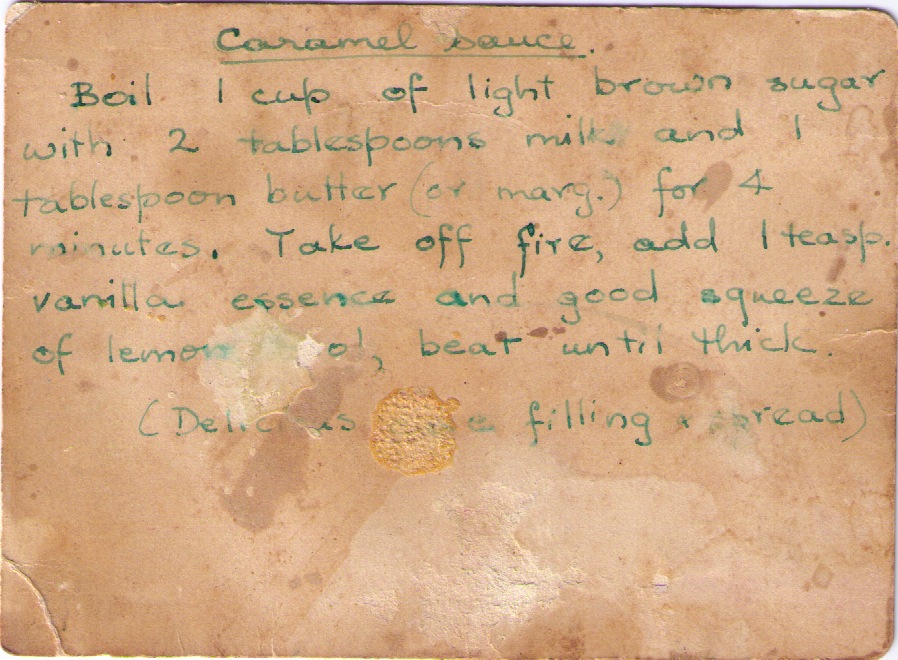
Thank you, Moi, for handing me the recipe card that you found recently (see pic). In Mum’s hand, is the recipe for Caramel Sauce. This one, though, is not to be confused with the Linda Landers Caramel Sauce recipe. The former could be termed the ‘lite’ version but as both contain vast proportions of sugar, it really doesn’t matter! Having just tasted a wee swirl atop my ‘lite’ frozen yoghurt, I am definitely soaring in the heady stratosphere of a sugar high. I have very fond memories of scraping the last remnants of melted ice-cream and caramel sauce from my dessert bowl at Sunday lunch (no rude comments, please, about where that led me!).

CaramelRecipeCardCaramel Sauce (lite version!)
Good on ice-cream and keeps soft form in a jar to use as a cake filling or a spread. (Also good for surreptitious larder snacks – eaten by the teaspoon from the jar!). This recipe (thankfully) only makes a small amount (approx. 120g).

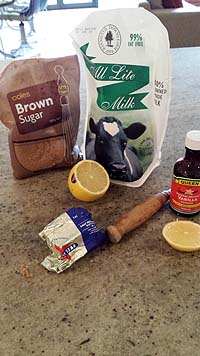
Boil 1 cup of light brown sugar with 2 tablespoons milk and 1tablespoon butter for 4 minutes.
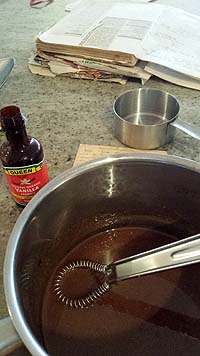
Take off fire, add 1 teaspoon vanilla essence and a good squeeze of lemon.
Beat until thick.

Linda LandersLinda Landers’ Caramel Sauce
Truly divine and decadent on vanilla ice-cream. Forms an increasingly gooey thick toffee coating atop the cold ice-cream, and can become hard, depending on your cooking technique.

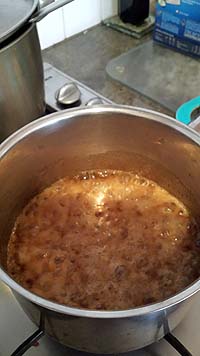
Bring slowly to the boil: 2 cups packed brown sugar, 2 tablespoons golden syrup, 2 tablespoons butter, 1 cup whipping or double cream.
Boil for 5 minutes. When off the stove beat in 2 teaspoons of vanilla essence.

Caramel04 Caramel05 Caramel09

CaramelRecipeCard

Rhubarb crumble, scones and banana oat bites (bobs)

Hi! It’s been another long pause between drinks (or posting). Please be assured, I hadn’t gone troppo; just life took the rev out of my extra-curricular activities. So let’s crack along before I’m distracted again.

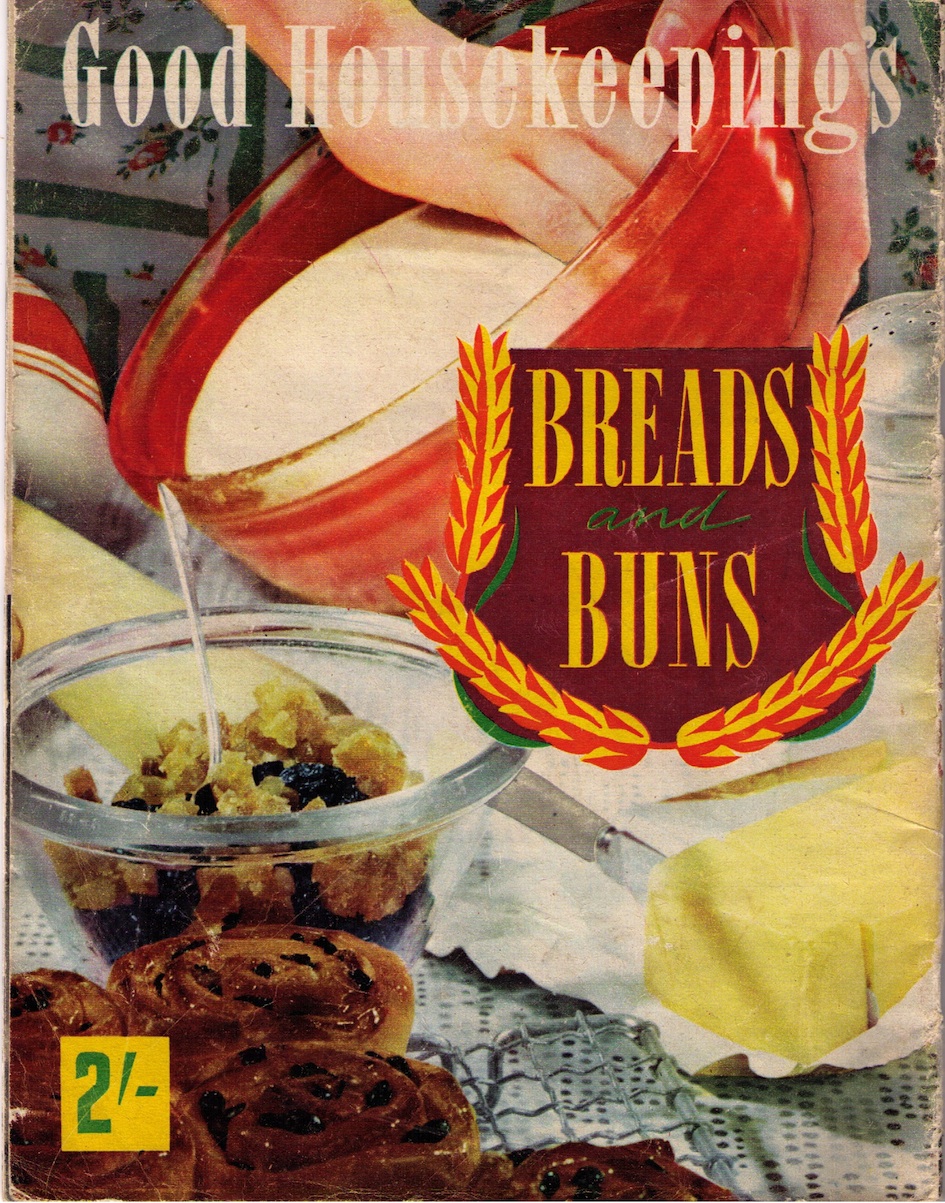
Good Housekeeping 1960

Wonderful colour of GH in 1960. A treasure trove of daily recipes.

There has been talk of the family’s appalling scone making record; no-one seems to be able to emulate Mum’s ‘quick as a flash’ scone making prowess. It may be that ‘speed’ is the critical element. So – this may help: I came across a 1960 Good Housekeeping pamphlet in the rabbit warren of Pamela’s hand-built cookbook.  Please let me know if the recipe below works for you, as I haven’t had another go recently.

I’m on a bit of a health kick at the moment and so the white sugar and white flour packets have been banished from the pantry. This also means that many of Mum’s recipes for puddings, pies and cakes are out of the question at the moment. HOWEVER – you can substitute with wholemeal, organic ingredients – she’d always support that.

Crumble was a big favourite round our family table; mainly due to an abundance of seasonal fruit from the garden and also it was quick. It’s a healthy dessert, as long as you don’t load up with too much brown sugar, and simply delicious as the crunch of the crumble meets the soft tart fruit and the silky touch of a dollop of fresh organic cream or ice-cream. Yum!

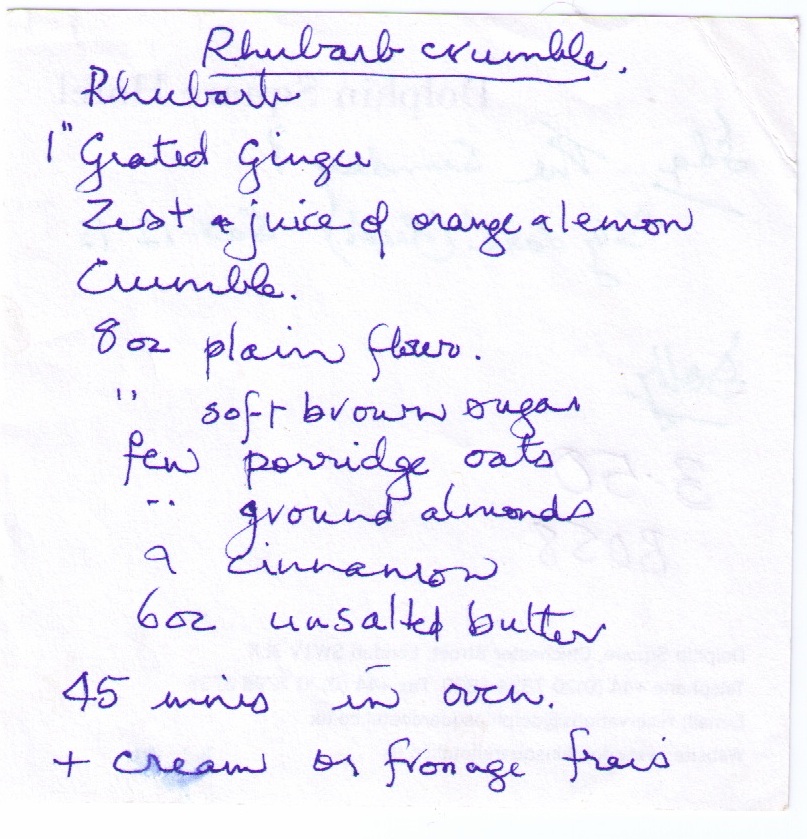
In her own hand - notice fromage frais (not easy to find in Oz but easier in UK)

In her own hand – notice fromage frais (not easy to find in Oz but easier in UK)

Mum’s recipe adds a bit of zest to your usual crumble, making it seem like you’ve created something deluxe without the effort. If you don’t grow your own fruit, I suggest a visit to your local farmers’ market to pick up whatever is in glut – the traders may have reject fruit that you can pick up for a song too – no harm in asking.

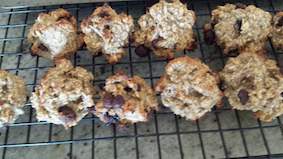
My last mini-ultra-quick-and-healthy recipe today is the Banana Oat Bites (aka Bobs) – these pop in the mouth lifesavers have diverted me from far worse indulgences and stopped a gap in a late afternoon hunger emergency. Ticking all the boxes, these little babies (sorry for the Jamie Oliverism) couldn’t be faster, particularly if you are a hoarder of black bananas in the freezer, as I am.

BOBS

Banana oat cookies

Quick, easy, healthy, sweet treats

Heat oven to 180C (approx 350F). Whizz 2 cups of porridge oats in your food processor, til they resemble a rough flour. Squeeze in 3 large bananas and whizz again. Grease a baking sheet or layer with baking paper. Dollop teaspoons of the mixture onto the tray and bake in oven for 15 mins. It should make approx. 24 bites – each bite being about 50 calories.

Additions: Today I’ve added a teaspoon of vanilla essence, a small handful of dark chocolate bits and a tablespoon of shredded coconut. You could add sultanas, other dried fruit like cranberries, peanut butter, nuts – whatever you fancy, but of course they’ll up the calories a wee bit.

RHUBARB CRUMBLE
The instructions are a bit slim but here goes:
Heat oven to 180C (approx 350F).
Chop about 4-6 big sticks of rhubarb and put in a saucepan. Grate in a thumb of ginger and add the zest and juice of an orange and a lemon. Simmer lightly til the rhubarb just begins to soften. Don’t boil it or you’ll have mush.

Spread out into a pudding/baking dish or into ramekins ( I like to do small individual ones, as they look good to serve up at a dinner party and keeping a few extra in the fridge are great for the kids’ after school tea.)
For the crumble: whizz together in a food processor 1 cup of wholemeal plain flour (white may taste better but this is healthier!) with 1 cup of your favourite muesli (failing that a cup of porridge oats are good), a tablespoon of ground or slivered almonds and 1 teaspoon of cinnamon. Then add in 1 cup of fair trade dark brown sugar and chopped up cubes of 6oz organic unsalted butter. Whizz until mixture looks like hefty breadcrumbs. Spread across your fruit and bake in oven for 15-20 mins.

PLAIN OVEN SCONES (Good Housekeeping Breads and Buns, 1960)
Heat oven to 230C (approx 450F).
8oz flour (try half white, half wholemeal), 
½ tsp salt, 1½ oz butter, 2 tsp cream of tartar, 1 tsp bicarb of soda, ¼ pint of milk + egg or milk to glaze. (If using baking powder instead of tartar and soda, use 2½tsp).
Sieve all dry ingredients and rub in the butter. Add all the milk at once – mix lightly and quickly (Mum used a knife) to a spongy dough and then knead slightly. Roll out to ¾ inch thick, cut out, brush with egg or milk and bake in a hot oven for about 10 mins til well risen and golden.

To make these sweeter, you can add a tablespoon of sugar and/or a large handful of dry fruit, e.g. sultanas, currants. I also like to make herby ones, by throwing in a large handful of parsley, chives and maybe basil or coriander. Grated cheddar cheese or small cubes of feta with a sprinkle of dry chilli flakes are good too!

Good luck everyone – please comment, post or email me with how your scones, crumble or bobs turned out!

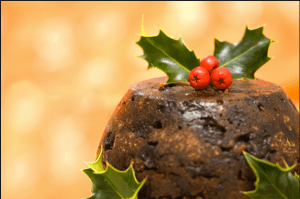
Pamela’s Plum Pudding

Christmas is usually a big affair at the Flockhart and extended family household. Much is made of tradition throughout the day and also for the Christmas Dinner. Auntie Ida used to come out to Longwood about 4-6 weeks before Christmas to help make the puddings and pies. We all had to have a stir of the pudding mixture for good luck and wrap money and charms to put inside it. Here’s the recipe that we all love so much, and hope you do too!

CHRISTMAS PUDDING (Pamela Flockhart)
Enough for 9-10 x 1pint/half kilo puddings, two medium sized puddings or a big one! I didn’t realise until I tried this myself that it makes a lot of pudding! If you want to just make one for your family of 4-6 I suggest you use only a third of the recipe amounts 🙂

Plum Pudding Recipe

Pamela’s Christmas pudding is rich and usually most enjoyed in the days after Christmas – warmed or cold with cream!


FRUIT: DRY INGREDIENTS:
  1. 450g currants
  2. 450g seedless raisins
  3. 350g sultanas
  4. 225g muscatel raisins
  5. 110g glace cherries
  6. 110g preserved ginger
  7. 110g dried apricots or peaches
  8. 110g candied orange peel
  9. 110g candied citron peel
  10. 50g candied lemon peel
  11. 225g shredded almonds
  12. 225g finely grated carrot
  13. 2 teaspoons glycerine
  1. 280g White breadcrumbs
  2. 170g Brown breadcrumbs
  3. 280g Plain flour
  4. 2 tsp Baking powder
  5. 2 tsp Salt
  6. 2 tsp Cinnamon
  7. ½ tsp Mixed spice
  8. ¼ tsp Ground ginger
  9. 1 tsp Ground Nutmeg
  10. 1 ½ tsp Ground mace
OTHER INGREDIENTS: A. PREPARE BASINS:
  1. 225g Butter
  2. 225g Suet (sub with grated frozen butter or vegetable shortening)
  3. 450g Cooking apples, peeled & chopped
  4. 225g White Sugar
  5. 225g Brown Sugar
  6. 8-9 eggs
  7. 3 tbsp Golden syrup
  8. 3 tbsp Black treacle
  9. 140ml Brandy/rum/whisky/sherry
  10. 140-240ml Old ale/stout/sherry/wine
Grease and line bottom of pudding basins with a circular disk of baking/greaseproof paper.Cover puddings with 2 circular disks of baking/greaseproof paper, 5cm wider diameter than basin. Use an old sheet to wrap up the basin, tie with a drawstring around top and make a small handle. Scald cloth & sprinkle with flour.
B. PREPARING MIXTURE: C. MIXING THE PUDDING:
  • Clean & prepare fruit.
  • Chop into smaller pieces if too large. Peel & grate carrots.
  • Mix altogether.
  • Sprinkle with glycerine.
  • Mix crumbs in and cover.

Leave in a cool place overnight.

  • Sift together in a very large bowl the flour, slat, baking powder and spices.
  • Cut in the butter & suet till mixture resembles fine breadcrumbs.
  • Add sugar, then crumbs and the apple.
  • Add the fruit & mix well
  • Beat eggs well and stir into muxture gradually
  • Warm the syrup & treacle and stir in
  • Stir in the spirits

Mixture should be moist enough to drop easily from a spoon but not runny.

D. FILLING THE BASINS E. COOKING TIME
  1. Fill each basin about ¾ full
  2. If money or charms are to be included – boil first in a little water and wrap well in baking paper, and lay in at intervals as you fill the basin.
  3. Smooth over the top & make a little hollow in the middle.
  4. Cover well with baking paper
  5. Wrap in cotton (old sheet)/foil and tie up with string.
  6. Scald and sprinkle with flour.
  1. Set basins on a rack in a pot of boiling water.
  2. Boil for at least 4-5 hours
  3. (Make sure water doesn’t get into the pudding and that your pot does not boil dry!)
  4. Store in a cool place
  5. On Christmas day boil again for a further 2 hours.

(If microwaving, do not put foil or money in! A 450g pudding can be zapped on high for 3 minutes and left to stand for a couple – a large pudding is better steamed).

SERVING  
  1. Unwrap pudding, carefully loosen edges and upturn onto a heatproof plate – watch out,  it will be steamy hot! Remove any baking paper.
  2. Make sure that you have a clear, unobstructed route to the table. And that there is a place to set the pudding down on a mat. (Look out for draped decorations that could catch fire.)
  3. Pour a cup or two of rum or brandy over the pudding and strike a long match or lighter. Touch the flame to the base of the pudding. As soon as the low blue flame covers the pudding, parade the pudding into the dining room (preferably to singing or the bagpipes) and ceremoniously place on table mat.
  4. Garnish with holly, if desired.
  5. Serve with brandy butter and/or cream.
pudding ingredients

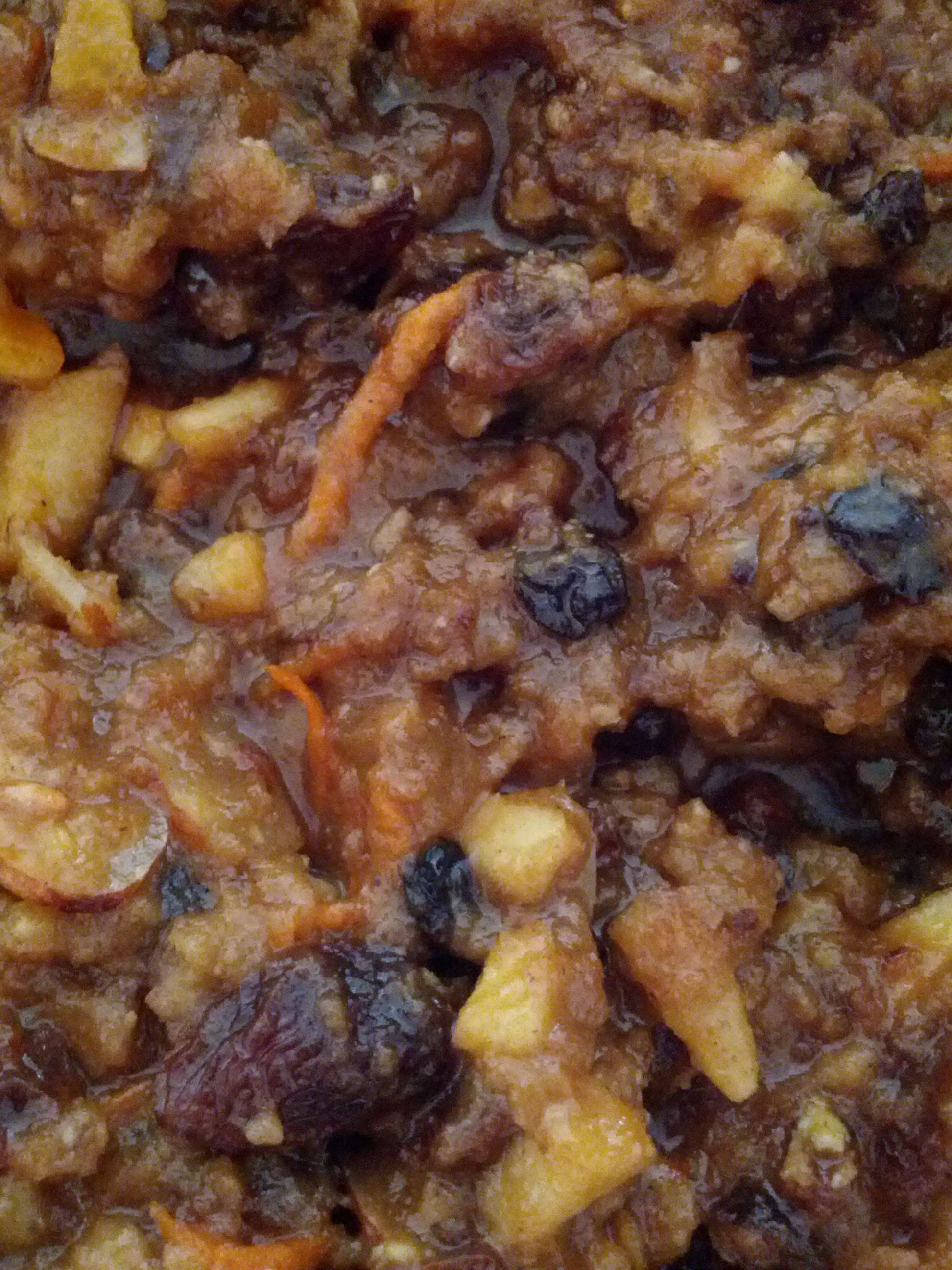
The mixture in process. It darkens in colour after adding the treacle.

Squidgy (gluten-free) chocolate wrap cake thing

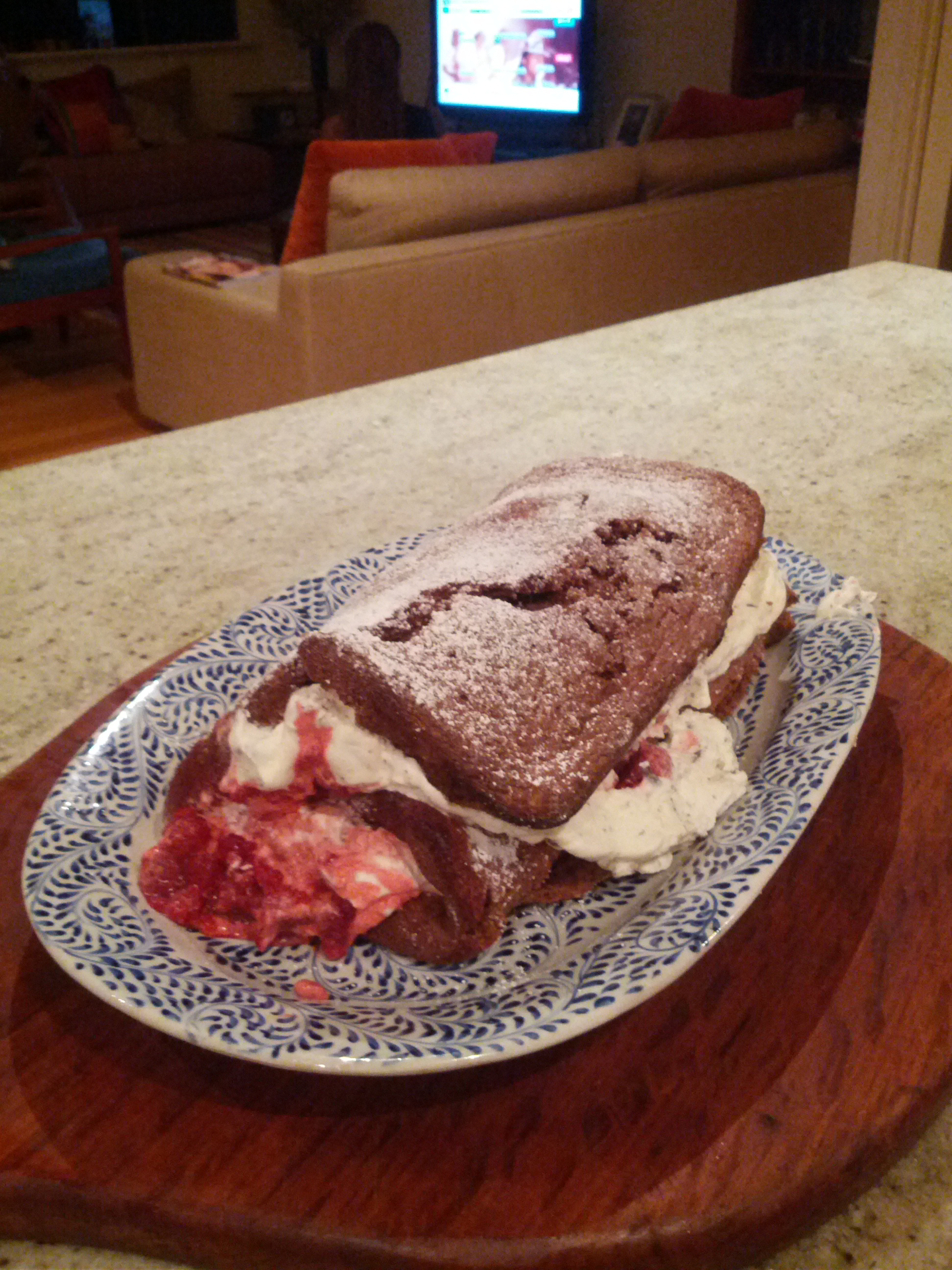
I had forgotten how easy, and quick to make, this ruinous dessert is. It was a regular favourite in the 80s after someone brought one over for a dinner party. I’m not sure of the origin but it could be Delia Smith or Miss Bell. I made it this week for Zoe’s going away dinner – my gorgeous girl is off to university already. We were all amazed at how good it was! There is no flour included but it’s pretty high on the fats and sugars – you can’t have everything I guess when you want your cake and to eat it too! It’s not as formal as a roulade and certainly I like the casual way it is folded.

IMG_20130219_195546

Squidgy chocolate wrap cake thing

Cake: 6 eggs (preferably room temp & free range of course!), 5oz caster sugar, 2oz fair trade cocoa (sifted);

Filling: 8oz double cream, block of dark chocolate and/or chocolate cream.

Turn on oven to 180 C degrees (350 F). Oil and line with baking paper a rectangular cake tin or roasting tin. (I used a baking tin with a 12 x 8 inch base).

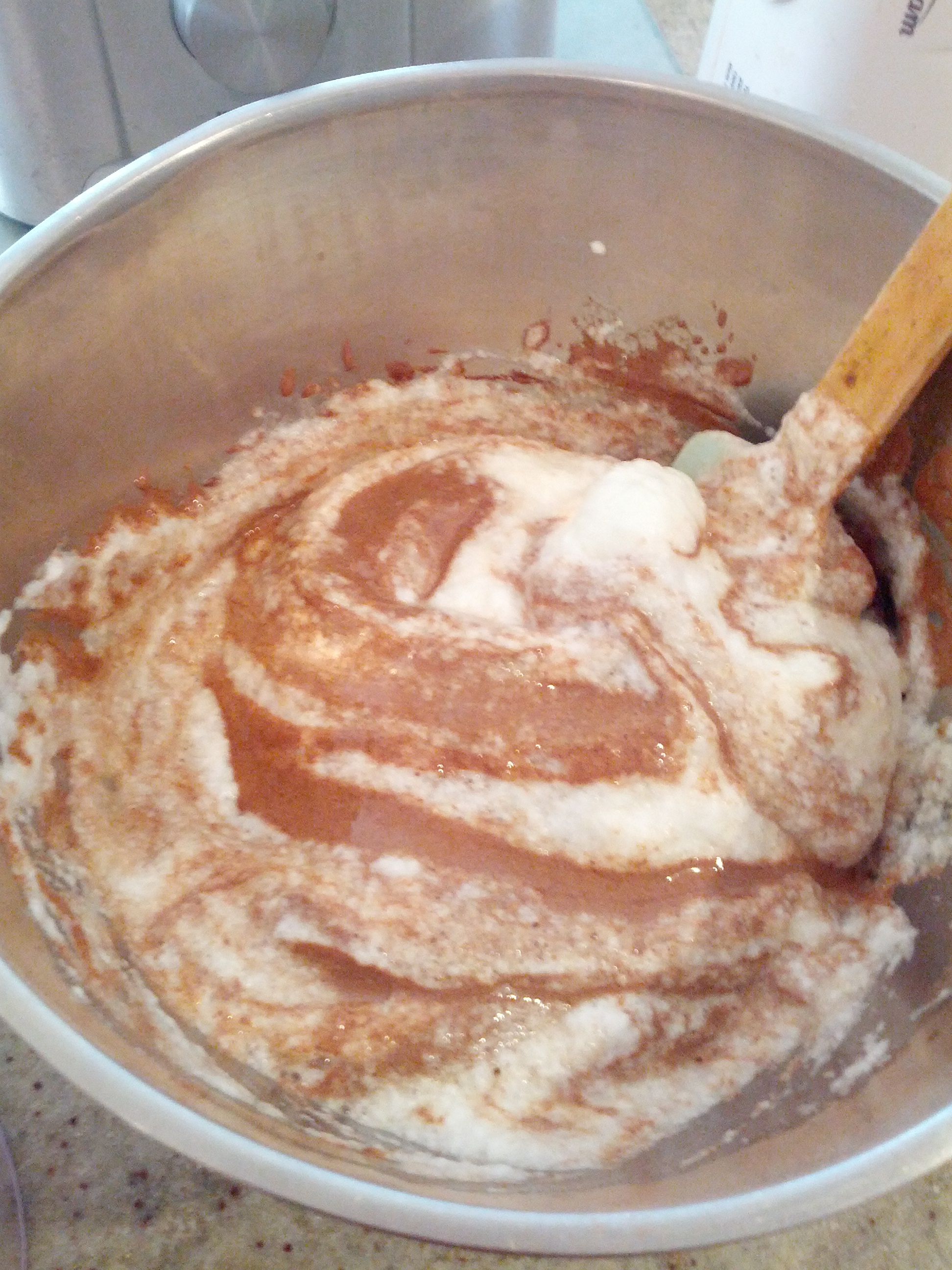
Separate the eggs and whisk the whites until soft peaks form but not stiff. Then, in a separate bowl, whisk the yolks lightly and add the sugar. When creamy add the sifted cocoa. Fold the whites into the cocoa mixture.

Fold in the whites lightly.

Fold in the whites lightly.

When mixed, pour into the tin and spread evenly. Bake for 15-20 minutes. When it’s cooling, it will contract a bit so don’t be alarmed!

Stretch out a length of baking/greaseproof paper and sprinkle it with icing sugar. When the cake is still warm, tip it out onto the paper.

For the filling you can spread layers of chocolate cream or mouse (see below) and whipped cream; this time I whipped the cream and folded melted dark chocolate into the cream which, as it cooled in the cream, created crackly chocolate striations. I then added a layer of mixed berries.

After spreading on your filling, to make the loose roll, lift the end of the baking paper and roll it over (as per photo). To finish, sprinkle with sifted icing sugar. (Tip: I think it’s easier to fold over when it’s still a little warm, i.e. pliable.)

Chocolate Cream

1/2 cup of butter (100g -ish), 1 egg yolk, 6oz dark 70% chocolate (fair trade, melted and cooled), 1 tbsp cognac or sherry, 1/2 tsp vanilla essence.

Cream the butter, beat in the chocolate, egg yolk, cognac/sherry and vanilla.

Oatmeal Stuffing for Roast Chicken

Sunday lunch was always a social event while we were growing up. My memories are mostly set at the, what seemed to me at the time, an enormously long table in the upstairs dining room of the Georgian 48 Polwarth Terrace  (I lived there from age 1-10). I can see the 60s blue curtains and similar table cloth, as well as wince at the thought of when I ran full pelt around the table and whacked my head on the corner of a night storage heater – my temple still bears the scar 44 years later! My brothers will recall Sundays at the Buccleugh, Northfield and Carberry dining tables, so it would be nice to hear abut them – boys?

International visitors either studying in Edinburgh or Aussie rellies, teachers and lecturers, friends and adopted maiden aunts frequently joined us. Cousin Ant came back with Mum from Australia in 1971 was a regular at the table, also the Rowlands, Hollingworths, Musich’s and other post grad students who lived in the flat at the back of the house.

It was simple fare – usually roast chicken, sometimes pork, very rarely beef and, once we moved to East Lothian, our home grown delicious Longwood lamb. A fruit crumble, sponge or apple pie with ‘fluff’ usually followed for pudding, in the 60s and 70s.

A perennial factor was the roast chicken’s oatmeal stuffing. I’m not sure where Mum learnt this one, but being oatmeal it sounds quite Scottish, and perhaps Mum learnt it in Aberdeen – perhaps Andy or Dad can tell us?

Andy recorded the simple recipe, over the phone:

OATMEAL STUFFING FOR ROAST CHICKEN

Take an onion and chop up finely.
Put in a pan with about a dessert spoonful of butter and some bacon fat, (if you have it). 
Add a desert spoon of chopped dried herbs and simmer till well mixed.
Keep moist!
Add some chopped streaky bacon.
Then add a cup of oatmeal but not so much it becomes dry. 
Stir and make sure it sticks (or becomes sticky). 
Then stuff in the chicken.

Oatmeal stuffing for roast chicken

Oatmeal stuffing for roast chicken

Scones!

I’ve never been very good at scones, I don’t make them very often (that’s probably why), mainly because I don’t think I’ll ever be able to achieve the ease of throwing together an awesome scone like Pam. So it was with trepidation that I attempted scones this morning. The incentive –  so Hugo had something to take along to friends for morning tea (that’s what we call mid morning snack in Australia) and also because I promised Mike Small that I would post Pam’s Scone recipe!

Mum grew up in Australia and, as in Scotland, the Country Women’s Association or Women’s Rural Institute is famous for its scone making prowess. The simplest of recipes can be the most challenging and floor even the most accomplished chefs (as a recent MasterChef episode illustrated). Mum learnt to make scones with ‘Gravy’ (aka Ms Graves) – the most resourceful cook and dressmaker I have ever come across and who supported my grandmother in raising her 4 children alone in Sydney in the 1940s. Both Gravy and Mum loved the CWA and Australian Women’s Weekly recipe books.

Pamela’s scone tips:

  • don’t over work the dough (when a scone recipe says to knead the dough, all you are doing is pushing the mixture together and bringing it to a relative uni form). Mum made scones in a block on a baking tray, not cookie cutter scones, which probably accounts for the rougher texture of her scones. (They wouldn’t have won prizes at the local county show! She did win prizes for all sorts of other things though ….:-)
  • use a knife to mix in the milk
  • preferably use milk that’s gone off
  • to keep warm and soft, wrap in or cover with a clean tea-towel
  • eat them fresh out of the oven, warm with real butter and home made jam
  • a hot oven (at Longwood, the Aga top oven)
  • and generally I’m pretty sure that speed actually helps the lightness of a scone’s being…
Basic Scone

Basic Scone

BASIC SCONES a la PAMELA (makes about 12)

Heat your oven to 220 degrees. Oil and flour a small baking tray.
Use a knife to stir a dessert spoon of caster sugar (optional*) into 3 cups of SR flour (or plain flour + 3 tsp baking powder). Add a pinch of salt. Make a well in the centre, and with the knife, mix in 1 cup of milk (room temp is best) until you create a soft dough (you might have to add another tablespoon of milk; don’t add too much though or it will become too sticky). Use your hands to grab all the dough from the bowl into one large ball. (Do not knead as your scone will become heavy.) Press out the dough onto the tray to make a rectangle about 1.5cm thick and score into approx 12 squares. Brush the top with milk. Pop in the oven on the top shelf for about 12 minutes. Turn out onto a wire rack for a short cooling and cover with a clean tea towel.
Serve warm with just butter or decadent cream and jam.

[For a richer flavour, you can rub 25g of butter or marg into the SR flour with your fingertips til the mixture resembles breadcrumbs or I like to use half milk, half cream.]

* Mostly sugar was not added into the main mixture (kids probably would prefer it), because the jam usually adds enough sugar.

DIVERSIFYING YOUR SCONES

At the  sugar stage you could add chopped dates, sultanas, cheese etc. At the Longwood Bakehouse organic flour was always used, but usually white for scones. For a wholemeal scone that tastes okay and is not like a brick, I recommend using 1 cup wholemeal, 1 cup white. I haven’t tried scones with quinoa, pumpkin and sunflower seeds etc but I think that would enter the ‘muffin’ genre of scone-making. Please comment and share your favourite scone variations.

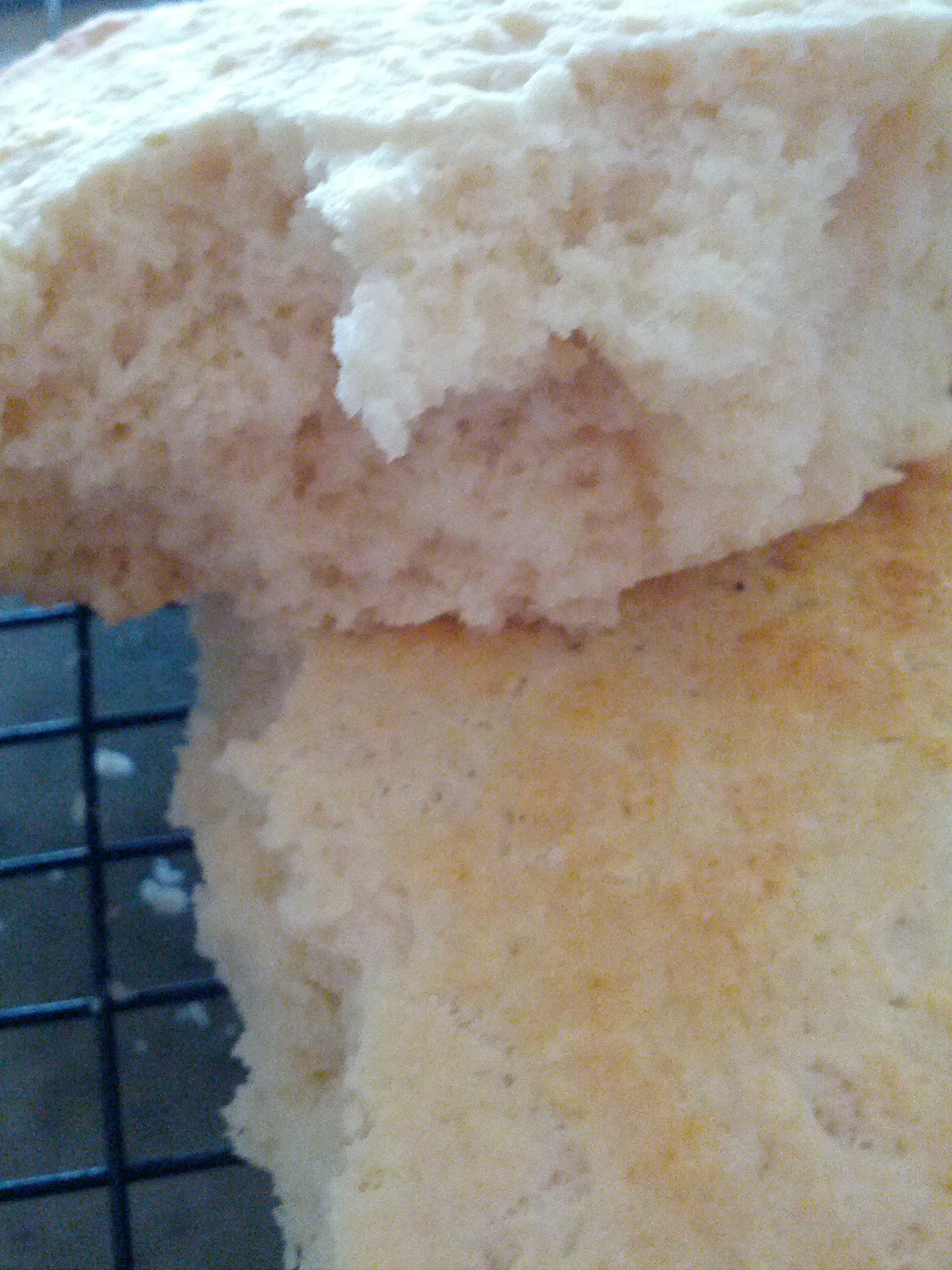
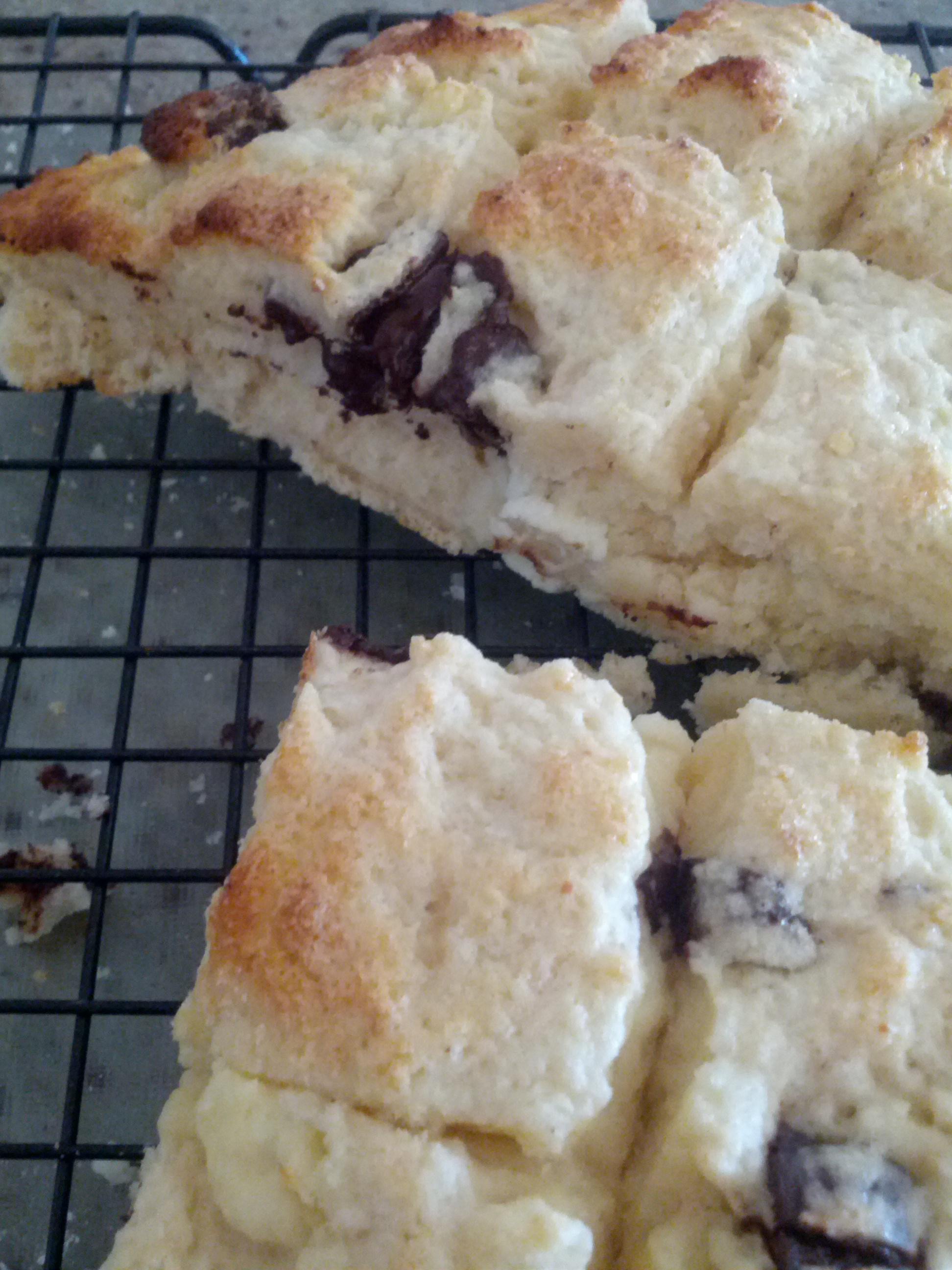
This morning I experimented with ricotta and dark chocolate ….

Chocolate Ricotta Scones

Chocolate Ricotta Scones

Chocolate Ricotta Scones

I replaced the 1 cup of milk with 1/2 cup of Ricotta + 1/2 cup milk. I broke up 2 pieces of Lindt 85% dark chocolate into shards and stirred these in with the knife before adding the last bit of milk. Also, after brushing with milk, I sprinkled the surface with sugar ( I used caster but brown would have been better). Hugo will let us know if they were palatable……?

Chicken with chorizo, prunes and crispy almonds

I’m not sure where this recipe came from originally, possibly a magazine. It certainly was a regular favourite in recent years and my daughter Zoe loves it!

Serves approx 4. 8 free range chicken thighs, 1 chorizo, 16 ready to eat prunes, small glass dry white wine, 300 ml chicken stock, fresh thyme, knob of butter, large handful whole almonds, sea salt, quarter pint single cream.

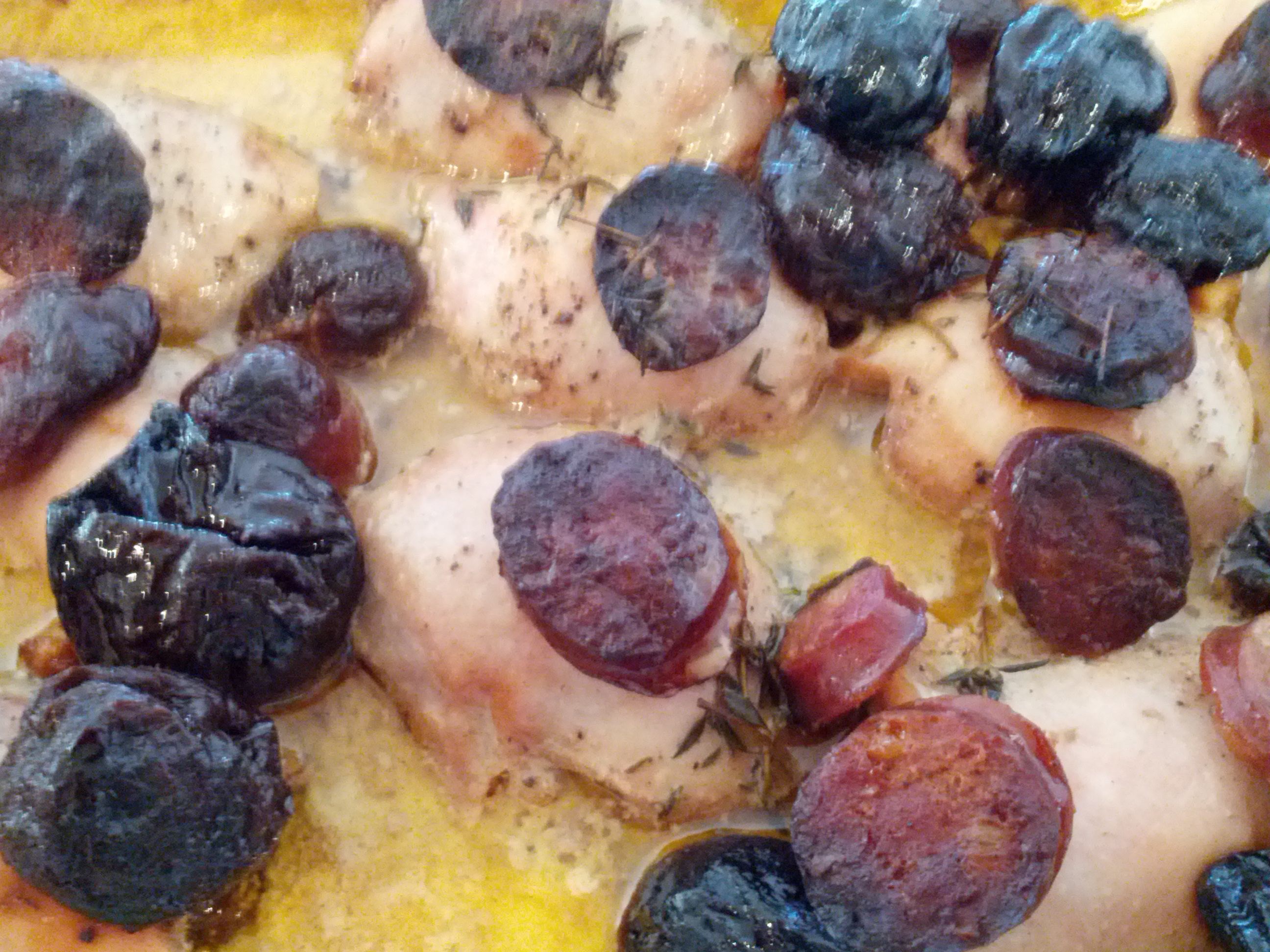
I know this doesn't look particularly appetising but it was really yummy. Some of the chorizo is a little charred and the other black things are the prunes!

I know this doesn’t look particularly appetising but it was really yummy. Some of the chorizo is a little charred and the other black things are the prunes!

Arrange chicken thighs in a roasting tin or baking dish. Finely slice a large chorizo and place the slices on top of the thighs. Season with ground pepper. Scatter the prunes about the dish. Mix the wine and stock and then pour over. Scatter the thyme and cook for around 30-40 minutes. In the meantime, sizzle almonds in melted butter for 2-3 minutes, and set aside. Remove the chicken, prunes etc to a warmed dish, cover. Reduce the remaining juices in the tin/dish to half. Add the cream, stir til smooth and pour over the chicken etc. Sprinkle the almonds with sea salt and scatter over the chicken. Serve with crispy green veg, such as courgettes, green beans and a great glass of Australian dry white wine!

TIPS: scatter the almonds on top just before serving – they will be nice and crunchy, adding an extra dimension to your dish!

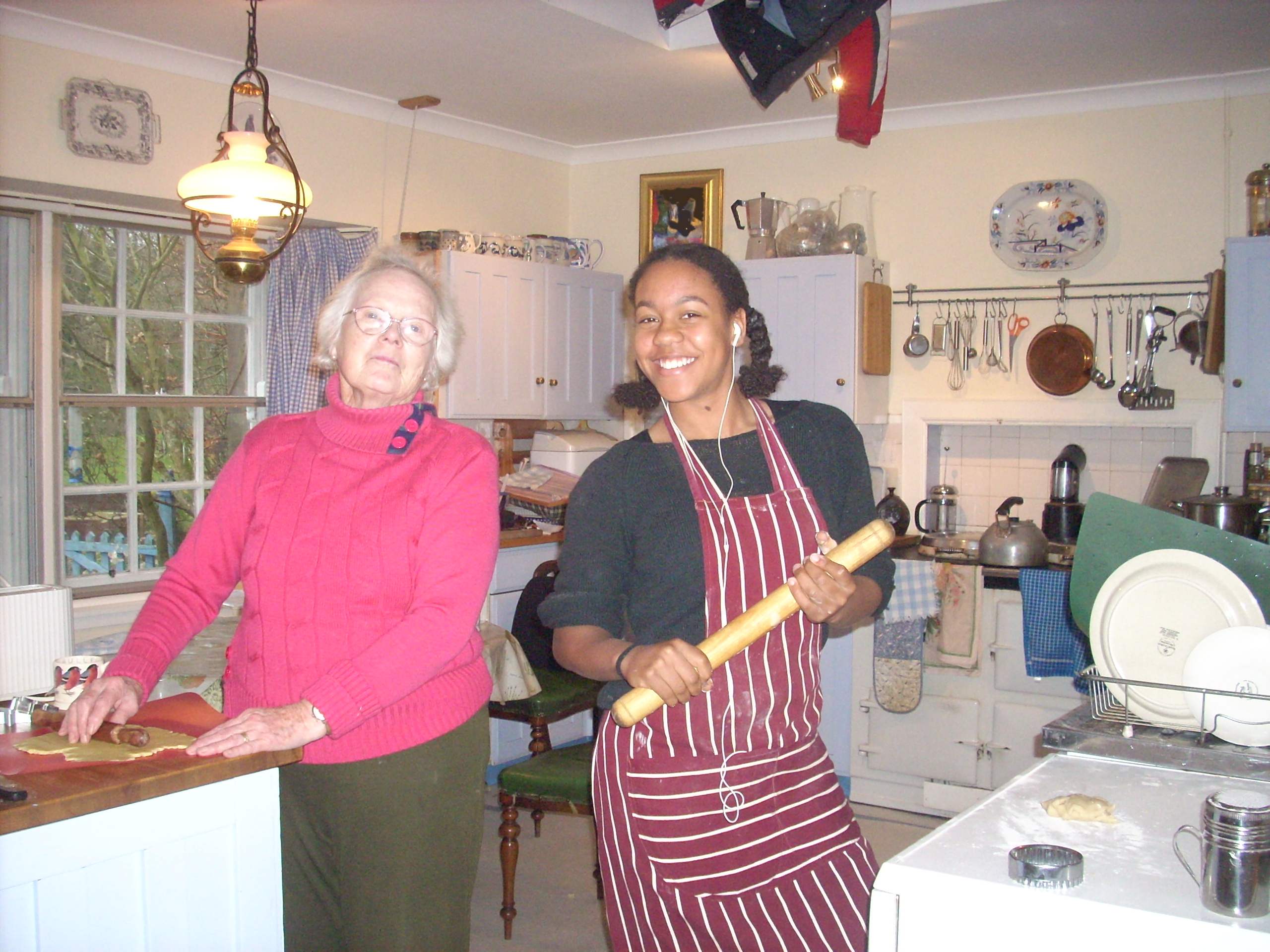
Grandma's cooking class - Pamela and Zoe at work in the Longwood kitchen

Grandma’s cooking class – Pamela and Zoe at work in the Longwood kitchen, December 2008

Welcome! I’m just getting started!

LB Logo

This blog is all about sharing Pamela’s wonderful collection of recipes with family, friends and the community that enjoyed so many of her meals around the Longwood kitchen table and all the other Flockhart family homes over the years.

Pamela Ellison Flockhart (nee Macartney) was an avid home-maker and superb cook – cooking for the five thousand was a regular feat and delivered with ease over the 61 years of her marriage to Ross, nourishing five children, five grandchildren and whoever walked in the continually open back door. An architect by profession she performed the duties of a minister’s wife for many years and continued in the same ways long after my father left the occupation. Pamela was a role model to many who inspired us all with her effortless hospitality, her good nature and level-headed advice.

My brothers, David, Andrew and Patrick, and I, as well as my sisters-in-law over the years have been known to ring Mum with an urgent request for one of her classic recipes – no matter where we were living at the time – it could have been Tennessee, Taiwan, Australia, Malaysia or France.

Many of these recipes were stashed in a notebook that my grandmother, Thelma Macartney (nee Buchanan) gave mum in the 1950’s – an imperial sized lined notebook – the sort that were standard issue in Australian schools at the time. This book now lies in tatters next to me on my desk, held together with rubber bands and yellowy sticky tape. It contains many of Pamela’s favourite recipes collected from many sources, either clipped from magazines, shared by friends or requested from a restaurant. What it doesn’t contain, and which are sadly now lost, are her tips on how to vary the recipe or to shortcut the process. She had an inimitable way of throwing ingredients together without too much care for measuring exactly and was always adventurous in replacing an ingredient with another if it wasn’t in her generously stocked pantry.

I’m not sure of the exact date when she decided to start the Longwood Bakehouse (or indeed when she closed it; I’m sure Dad or my brothers will set me straight) but I think it must have been running from the early 1980’s into the mid-90’s.

The Bakehouse was our family country kitchen, in East Lothian, where Mum used stoneground organically grown wholewheat flour and free range eggs to produce a variety of bread, rolls, quiches, pizzas, cakes and pavlovas. Rising at around 3am five days a week to mix and knead, prove and bake became the ritual that my father joined, helping Mum before he drove 20 miles into Edinburgh for a day at the office (delivering bread on the way!).

This blog is an attempt to share Pamela’s Longwood Bakehouse Recipe Book with all the family, friends and community that so enjoyed many meals around the Longwood kitchen table or the dining tables of the Polwarth, Pentland View, Northfield, Iona, Buccleugh Place, Argyll Crescent and Sydney homes.

Please leave your comments and anecdotes about Pamela and her recipe collection, especially if you recall any of her special tips!